A chimney cap is the metal cover over the flue opening. It keeps rain, birds, and debris out and, when fitted with spark-arrestor mesh, blocks embers from landing on the roof. Wind is the most common reason Hayward…
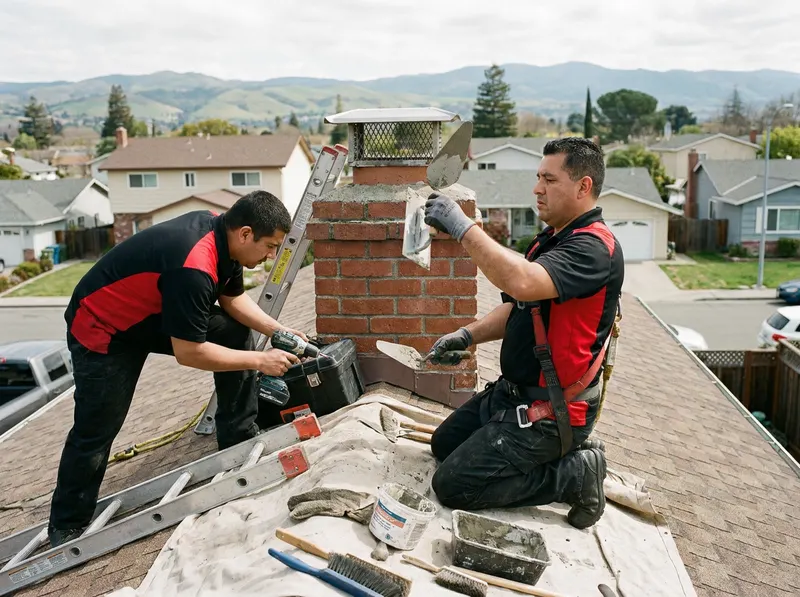
A chimney cap is the metal cover over the flue opening. It keeps rain, birds, and debris out and, when fitted with spark-arrestor mesh, blocks embers from landing on the roof. Wind is the most common reason Hayward homeowners search for repair, the gusts that funnel across the ridgelines above Hayward Highland and Fairway Park regularly lift a friction-fit cap off its flue tile, and homeowners describe it as the wind having "blew my chimney cap back from my chimney." A cap sitting on the roof or hanging by one screw is something a technician can take a look at and, in most cases, reattach the same visit.
The repair path depends on what is actually damaged. If the cap is intact and only the mounting slipped, reattachment with new stainless screws or a friction-lock band restores it, the least expensive fix. If the cap shows rust-through, crushed mesh, or a bent lid, chimney cap replacement is the durable route: a stainless-steel cap resists corrosion in Hayward's marine-influenced air far longer than galvanized, which is why 304-grade stainless is the common specification. Single-flue caps clamp directly onto a round or square flue tile; multi-flue and outside-mount caps cover the entire crown and are sized to the crown's outside dimensions, so exact measurements are taken on site before ordering.
Cap damage and crown damage often travel together. The chimney crown is the concrete or mortar slab that slopes water away from the flue. When it cracks, water reaches the cap anchors and the top courses of brick, so chimney crown repair, patching hairline cracks with a flexible crown sealant or rebuilding a failed slab, is frequently recommended alongside cap work. During any cap visit the crown, flue tile, and mortar joints are examined; this follows the Level 1 inspection scope defined by NFPA 211 and referenced by the Chimney Safety Institute of America (CSIA). A missing cap that let water and animals into the flue can prompt a Level 2 inspection with a camera before the chimney is used again.
Deciding between repair and replacement comes down to the cap's condition and age. If the cap is under a few years old, made of stainless, and simply blew loose, reattaching it is the sensible choice. If it is galvanized, rusting, or dented from a fall, replacement avoids a second call within a season or two. Homeowners in Cherryland, Jackson Triangle, Glen Eden, Longwood-Winton Grove, Southgate, Harder-Tennyson, Palma Ceia, and Mount Eden get the same on-site measurement and a documented photo report either way, so the recommendation is grounded in what the cap and crown actually show, not a sales script. A free on-site estimate confirms cap size, crown condition, and the exact price before any work begins.
Every job gets a firm, written price after a free on-site visit.
Tell us about your chimney cap repair & replacement job in Hayward and we'll send a clear, written quote, usually the same day.
 Hearthmaster Chimney Sweep