Water enters a Hayward chimney at predictable spots, and the repair depends entirely on which one is failing. A cracked concrete crown, the sloped top slab, sheds water into the flue and brick; hairline cracks are…
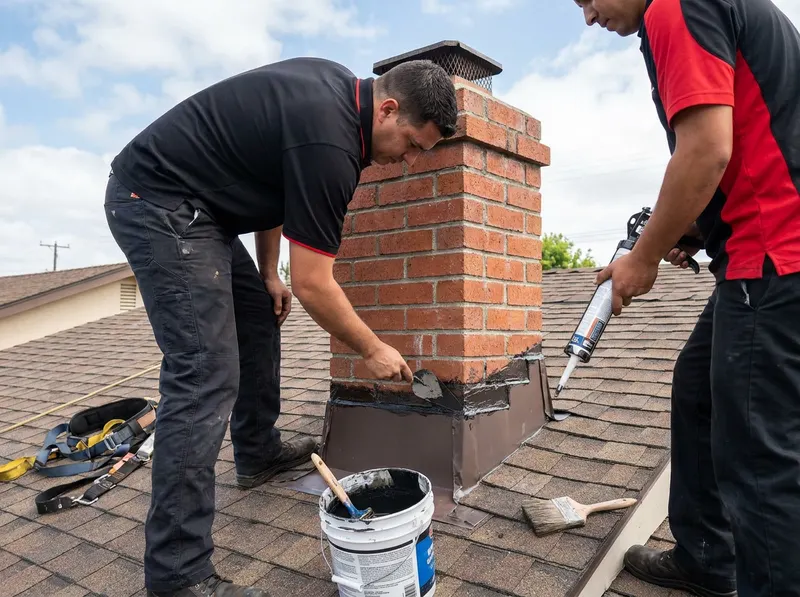
Water enters a Hayward chimney at predictable spots, and the repair depends entirely on which one is failing. A cracked concrete crown, the sloped top slab, sheds water into the flue and brick; hairline cracks are patched with a flexible crown sealant, while a crown broken through its full thickness usually needs a rebuild. Flashing failure, where the metal seals the roofline joint, is the most frequent cause of a home chimney water leak in older Fairway Park and Cherryland roofs, and it is reflashed and resealed rather than patched with caulk that lasts one season. A missing or rusted cap lets rain fall straight down the flue, so cap replacement is often the cheapest fix. When the brick itself is soaking through, waterproofing with a breathable repellent is the answer.
Waterproofing is not paint. A vapor-permeable siloxane repellent, the type the Chimney Safety Institute of America (CSIA) recommends, lets trapped moisture escape while blocking wind-driven rain, a sealer that traps vapor spalls the brick face within a few winters. This matters on exposed slopes in Hayward Highland and along the ridgelines near Garin Regional Park, where south and west chimney faces take the brunt of winter storms rolling in off the Bay. A single coat covers a standard masonry chimney and typically holds for 7 to 10 years before reapplication.
Deciding between a targeted repair and full waterproofing comes down to the inspection. If staining shows only on the ceiling directly around the chimney chase and the brick reads dry on a moisture check, the source is almost always flashing or crown, a repair, not a waterproofing job. If the brick is dark, efflorescent (white salt bloom), or spalling across the whole stack, water is passing through the masonry and a repellent is warranted, often paired with tuckpointing first so the sealant bonds to sound mortar. Waterproofing bare, already-cracked brick without repairing joints wastes the coating. A Level 1 inspection covers readily accessible areas; a Level 2 inspection, which includes video scanning of the flue, is used after a leak, a property sale, or a suspected internal breach, the NFPA 211 standard specifies Level 2 whenever a chimney has been affected by a building event or water intrusion.
A leaking chimney repair follows a set order. First, the inspection locates and photographs the entry point. Second, a written scope and price range is given on-site, the free estimate covers this. Third, repairs are staged from the top down: cap and crown, then flashing, then masonry, then the water repellent last so it seals a chimney that is already structurally dry. Every visit ends with photos of the finished work, not a verbal 'trust us.' Homes in Jackson Triangle, Southgate, Mount Eden, Glen Eden, Longwood-Winton Grove, Palma Ceia, and Harder-Tennyson fall within the standard service area across Alameda County.
Every job gets a firm, written price after a free on-site visit.
Tell us about your chimney leak repair & waterproofing job in Hayward and we'll send a clear, written quote, usually the same day.
 Hearthmaster Chimney Sweep